

Reports and Tools
APPILISTIC'S CLUBHOUSE DATABASE
In development since 1999, The Clubhouse Database has been designed to meet the unique member data collection and reporting needs of mental health facilities organized around the clubhouse model. Personal Folders, Goals, Supports, Attendance, Employment, Member Access and Build-It-Yourself modules are now in use at locations from Miami, Florida to Anchorage, Alaska. Extensive help is available in all modules. The Clubhouse Database design philosophy includes two overriding principles: 1) Maximize data security, and 2) Maximize the potential for member participation in the data entry and reporting process.
Data Security: Built in security elements available at your option include:
- User specific login ID and password
- Adjustable, user specific permission settings which can be used to enforce the principle of least privilege
- Adjustable, minimum password settings
- Member privacy settings
- Automatic distributed backup system
- Adjustable data locking schedule
- Adjustable auto-lock for modules inadvertently left unattended
- Audit log
- Data encryption
Your local database administrator has access to all features and all data in the database. However, the audit log locks in the ON position to ensure continuity of the collected information. See details.
Individual Members can be given access to their own information.
Member privacy (or contact) settings allow each member to decide how they can be contacted by staff and members. For example, if a member restricts contact by phone, their telephone number will not appear on outreach lists. Information is never restricted from "Emergency Information Sheets."
Optional distributed backup means that each computer that is capable of accessing the Clubhouse database can also be used to automatically create encrypted backups of the data. Local backup dates are checked each time the database is opened, and backup copies are updated according to a schedule selected by the system administrator.
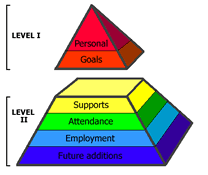
Member Participation: By supporting simultaneous data entry by multiple workers and utilizing a data pyramid design philosophy, Clubhouse Database maximizes the potential for member participation in the data entry and reporting process.
Under the data pyramid design philosophy, information critical to the database function and confidential information are entered at the highest levels of the pyramid by Staff or under close Staff control. Less sensitive data, such as in-out times and paycheck information, can be entered by trusted workers. In these areas, carefully designed data input screens utilize pulldown menus and error checking to maximize the potential for success.
Next, data verification tools enable staff to quickly verify the accuracy of entered data. These tools enable Workers to perform the bulk of data entry (base of the pyramid).
Finally, members can update their own personal folder and goal information without supervision once a personal password has been established for them by Staff.